Search This Blog

6/04/2011

LIKE HOLY WOMEN OF OLD...CALLING A HUSBAND 'MASTER'

Followers off the 'Biblical Womanhood' movement cite 1 Peter 3: 5-6  "...They were submissive to their own husbands, like Sarah, who obeyed Abraham and called him her master..."

The Wedding. M.Hudson2011
In the prophetic book of Hosea, God speaks to his people using the language of metaphor and marriage. The promise of better relationships with God was expressed in terms clearly identifying the nature of the interaction as being love, and not power, based.

"And it shall be in that day," says the Lord, "..[you] will call me, 'My Husband (Ishi)' and no longer call me, 'My Master (Baali)' (Hosea 2.16).

The clear message is that the way God wishes to interact with His people is not through power, authority, or control. Instead, God's wish is to be intimate, loving, protective, and supportive of His people.

Compare this to the often misused words of Paul in Ephesians 5.22 and  Peter's word above, telling women to submit to their husbands.  It is often used as a whip to prod women into 'their place' while ignoring the earlier verse about submitting to one another.

This is another excellent example of how scripture informs scripture. If God desires to no longer have his symbolic spouse view him as 'master' -  than human men should look to this as their own marital model. It is always better to have relationship than mere reverence.

A YEAR OF BIBLICAL WOMANHOOD


Author Rachel Held Evans is exploring living by the mandates of 'Biblical Womanhood' in its most literal applications.  From making her own clothes to calling her mate 'Master'....well you get the picture.  Read about her project here.


5/28/2011

A Strange Unity: Modesty and Coverings


"Modest'  for the Bat Israel  (Woman of Israel) means to dress 'not frumpy'  but with  elegance to fulfill their Tznuit (modesty) and bring their husbands joy.  Here is a site with samples of their apparel and styles, including headcoverings.   This site on orthodox Jewish dress includes both men and women.

"Modest" for some Christian groups has also meant wearing caps, veils, and scarves as seen here.  Some are protestant groups based in the Reformation and others are Catholic.  The LDS church also has very specific dress guidelines for modesty.  For others, it is a recent adaptation as seen here in a business that opened in 2002. They cite adopting the action in obedience to 1 Corinthian 11:1-16.  For other groups, being modest has meant plain dress, no makeup, no jewelry, long skirts, and long hair. Some younger women are changing this to emphasis more style while retaining the modesty.

"Modest" for Islamic women includes the scarf (Khimar), the total body covering (Hijab), and the face veil for the most devout (Niqab). You can read some rather detailed explanations of the rationales for wearing each and how they relate to worship by the devout Islamic woman here.   This site also, interestingly, reveals the dress codes for men to be considered modest within Islam.

Note, I could find no major websites addressing what it meant to be modest if a Christian man.

What is  modesty? In practical terms it is keeping revealed by clothing various parts of the human form which are deemed "private", "titillating", or "unseemly".  Thus, the breasts, arms, legs, hips, face, and head/hair are variously in need of coverings. No underwear may be seen through sleeves, no cleavage, and nothing too tight or form fitting to bring attention to the attributes marking the gender.  The primary belief among modest Christians is that the good deeds and faith will be the makeup and ornamentations of beauty.

Many will agree modern society has become extreme in its dress and fashion. The human form is constantly on display to promote sales, to evoke sexual thoughts, and to provoke interest. Dance moves  have become often mere grotesque pelvic thrusts and bizarre gyrations mimicking animal  lust rather than graceful, joyful,  or meaningful movements to music. Sexual encounters, references, and acts are seen as part of the normal entertainment cycle in books, music, movies, and on television. Children are being sexualized at earlier and earlier ages.  Women have become liberated and  yet abuse of women continues.  Prostitution a growing business and sexual affairs commonplace.   People wear veils, headcoverings, and long hair.  They dress in long sleeved dresses and wear no makeup but has that impacted the world for good?  Is there any evidence that those exterior 'things' have in any way helped the world, spread the gospel, feed the hungry, aided the poor, or soothed the hurting?

Will being 'modest' alone impact this sorry state of affairs?  Will retreating to communities or rural areas living a modest life make changes? Will legalistic-ally demanding compliance to a set of rules as to length of hair, cutting of hair, type of head covering, sleeves or no sleeves, really mean anything in the long run?

If it is really between a woman and her God....it should be between a woman and her God.  Her liberty should be to adopt the custom or not with NO outside interference or demands by religious groups.

For more, read my post on Where Did the Glory Go?, Could This Have Been in Paul's Mind? or my book THOSE PESKY VERSES OF PAUL, with a detailed look at 1 Corinthians 11.

5/15/2011

BEFORE THE FIRST BITE

"Before the action comes the thought."   

H.C. Leupold wrote commentary over the famous Genesis verses telling of the Fall of Humanity.   Of how the "serpent" utilized the first military tactic of 'divide and conquer' by approaching Eve alone in the Garden.  Leupold noted that had he approached the couple together they would have mutually supported and protected each other from the clever words which sought to tempt.

Interestingly, Leupold also infers something occurring which brought to mind the words of Jesus.  

For religious people of Jesus' day, as long you did not act on the thought you were blameless.  So, men might look at a woman with lust but as long as he did nothing to fulfill that lust he was safe.  Jesus, however, indicated that impurity in the thoughts was no different than the act..."he who has looked at woman with lust has already committed adultery with her."

Leupold writing in his Exposition of Genesis (Baker, 1945) stated the eating of the fruit was not the sin...it was the result of the sin.  The sin was not giving an immediate 'get thee behind me Satan!'    As Martin Luther wrote, it was a sin against the word of God - in this case the literal words of God spoken to not eat the fruit of that particular tree.  The willingness to listen to the anti-God whispers was the moment of sin.

Sometimes, we can be very self-satisfied that we did not act on the deed or desire that flitted through our minds or our hearts. We can applaud our sense of tolerance and open-mindedness about areas of ambiguousness.  

Instead, sometimes old adages such as where there is smoke there is fire should be recalled. Or, the words of Jesus about the thought  or desire preceeding the action.

Stop....before the first bite...

4/03/2011

NOW SHOWING FOR A LIMITED TIME ONLY!

Getting ready for God to do some BIG things today at [insert name of  Church]! Join us at 10am.


I have seen these posted on Facebook and other venues.  A couple of things disturb me about them.


1.  It is implied that God will only do BIG things in a church service.
2.  It is implied that God can be scheduled to perform, like a pet monkey or a trained canary.


If there is one thing I have learned about God in all my years it is this: God cannot be limited, confined, or scheduled.  God does not perform or do tricks. 


God can do BIG things anywhere and small ones too.   Alone or in a crowd God can be found and God can act.

4/02/2011

RAISE A GLASS OF ....WHAT?

Does the Bible prohibit drinking alcoholic beverages?  It is a question sure to stir the hearts of people on both sides of the issue.  The question is one that has haunted the church for many years. 

Those whose churches or experiences stem from the Holiness Movement of the 18th and 19th centuries will give a resounding "No!"   Those from other traditions will say, "What's the deal?"    

Two principles from the Bible come through clearly: Excess and Behavior.


Consider the following:


  • The Bible indicates wine 'cheers' both man and God (Judges 9.13)
  • Wine is a gift of God (Psalms 104.15).
  • Jesus' first miracle was to turn water into wine and not any fine, but the finest quality wine (John 2.10).
  • Lack of wine is considered a punishment or judgement (Jer. 48:43)


Excess Prohibited:

Being drunken brings abandonment of restraint, poor choices, risky behaviors, and stupid mistakes.  Prov. 20:1 "Wine is a mocker and strong drink is a brawler; whoever goes astray by them is not wise".  How does one go astray?  By following the path of no restraintGluttony, anger, and  other excesses are also to be avoided but somehow we have not been consistent with those.


Behavior:
Romans 14 and 1 Thessalonian 5:22 are both used to insure that no one ever does anything that might offend a weaker Christian or give the appearance of behaviors leading to assumptions.   Yet, in both of those elements are the seeds of problems for all - the drinker and the non-drinker.

The non-drinker, who may be weak or who may have a temptation to drink to excess, may be encouraged to participate in self-destructive behaviors.  The liberty or ease at which someone else does an act which may cause them to not develop in their spiritual life so that they are made more Christ like and strengthened.  

The drinker, or the person who has no problem or is not subject to abuse or excess, is then restrained from an action.  Because of the weaker person, the church often stresses, we should avoid all that gives the appearance of evil.

It is that term "evil" that begs questions.  If wine is a gift of God - is it really "evil"?    Would it not serve to be a better witness to be able to say, "No, I have had enough?"   To buck the trend of "drink till you puke"?  To show that restraint brings joy without excess and that excess is not a necessity to enjoying a glass of wine.


In a world filled with "Spring Break" madness, documentaries covering the 'World's Sexiest Bars", and similar glorifications of excess, it might be good to reexamine the concepts of excess and behaviors.  This would redefine the entire subject of personal righteousness from choices about dress, hair, and other non-essentials to actions of justice, love, peace, kindness, and sacrifice.


We can stand around with high and tight hair, long dresses, no makeup, never attend any 'questionable' activities, never use a swear word, and never taste wine.  We can attend church five days a week, sing in the choir, teach classes and serve in leadership.  We can also be a grave inside with no true transformation of the heart, filled with secret sins, and all manner of corrupt behaviors and motives.  


How we look on the outside and the minor things we might do can never be used to determine spirituality, holiness, or relationship with God.

3/20/2011

REDEFINING MISSION WORK

There is often a disconnect between what groups mean with they use the terms 'missions', 'mission work', and 'missionary.'


For some, the activity is narrowly defined by an evangelistic outreach where emphasis on preaching, crisis salvation, and witnessing on streets, in bars, and in other rough areas.  Still others view it as going into a socially, economically, or culturally different environment to bring them salvation, to bring them Biblical teaching and to be involved in the elevation of the society through the gospel.


For some, the activity is narrowly defined as the political, social, and cultural outreach where emphasis is on improving the quality of life, improving medical standards, and expanding the ability of a people to be self-sustaining.  Still others view it as revolutionary assistance to change, by force, the negative processes of a political or economic system.

Who is right?  The truly be reflective of the Biblical concept of mission work requires there be more depth to how we envision mission work.  

Centuries of the Western Church sending missionaries to 'save the heathen' also tended to reflect a paternalistic attitude.  The unspoken message was also sometimes racist.  How, after all, could the pagan ever be supervisors of the work in their countries?  This messiah-like and paternalistic attitude tended to influence all mission work from the 1700's and in some groups continues to this day.

Take responses to catastrophe in recent times.  We go to Central or South American, we go to Haiti and preach but do we roll up our sleeves and help in the rebuilding?  Do we take medical groups along to provide needed medical assistance as we witness of God's love through actions and words?  Do we go to feed, clothe, and care for the unloved and share the Gospel in our actions and not just our words?

What of our everyday opportunities just down the street?  The Infant Crisis Center, the Homeless Shelter, the Literacy Project, the Jobs Program, the Meals on Wheels, the Homebound Visitor Program, the Big Brother or Big Sister and so much more.  Are we being 'light' in the darkness of our own local backyards?

It is always easy to sweep in someplace with a superhero cape flapping the breeze behind you, looking important, feeling sanctimonious, and yet do nothing purposeful or meaningful to really be the hands and heart of Christ to those in need.

Sometimes it is good to reflect and in reflection redefine what we mean by 'mission work.'  Mission work is merely discipleship beyond our comfort zone, it is sharing the gospel and then empowering individuals to assume their roles as evangelists into their world. To do more is to create co-dependent ministry rather than wide spread redemption.


3/18/2011

SMALL THINGS MAKE A DIFFERENCE

There is a story in the book of Judges about a land dispute between two tribes, Ephraim and Gillead, who both needed access to a particular river crossing. As the conflict grew, the litmus test they devised was based on a form of credentialing to to allow access.

You see, the next to the last letter of the Hebrew language is pronounced differently depending on the placement of one small dot (Shin or Sin). The Gilieadites hit upon the idea of having persons who wished to use the ford pronounce the Hebrew word "Shibboleth". The Ephraimites would, by comparison, use the other pronunciations of "Siboleth." It was a simple test - answer correctly you crossed the river and answer incorrectly, by this test, and you died.

How ironic that the great letter, so to speak, they held in common was eclipsed by a small dot.
Now, how does this speak to us today?

Most of Christianity shares one great letter - a belief in Jesus Christ as Lord and Savior, a loving God, and redemption and atonement for sins - yet often we allow the small, tiny dot to divide rather than unite us.

Most of America shares one great letter - a love of country, state, community, family, and friends - yet often we allow the small, tiny dot to divide rather than unite us.
More importantly - any church - should also share the "big letter" and not be devisive and argue over the "little dot." When we argue over the minor, unimportant things we shame Christ and we are a false witness to the community. When we can't get along because we can't get our way - We are totally unChristian. we are "sinning". Such action requires - no demands - that we repent and we ask forgiveness of those we have wronged.

Could we- personally, corporately, communally - do what those tribal brothers could not do? Can we celebrate today a fresh determination to not allow the tiny dot to eclipse the great shared letter?

CHURCH FIGHTING

While researching another topic, I happened on this intriging little website. The blog entry of the title caught my eye because it seems lately that churches from all over are all complaining of the same thing: in-fighting, bad feelings, hurt feelings, power plays, and thinking of self. Pastors AND church people are complaining of church bullies and a lack of unity in their congregations. Hmmmm.

Sometimes we tend to want to look at things from a management viewpoint ("if they ran things right around here..."), a leadership issue ("if I was in charge..."), a peace perspective ("..if we can just all get along..."), or the old standby of tradition ("if we did things the way they used to..."), or a fear of change ("they are ruining things!).
In truth, all of these are symptoms of a problem.....but not one solved by meetings, committees, or by study groups. The problems are SPIRITUAL ones...or in truth a lack of God's Spirit in the midst of the congregational life.....some, like demonically incited attitudes of control, ego, unforgiveness, disunity, even problems in accepting that things change over time in music, worship and chruch formats....that can only be solved through "prayer and fasting"....

Let the CHURCH actually be the CHURCH OF GOD and GOODNESS and not EVIL.
"Be angry - but sin not. Do not let the sun go down on your anger, and do not make room for the devil. ..Let no evil talk come out of your mouths, but only what is useful for building up...And do not grieve the Holy Spirit of God....put away all bittnerness...wrath...anger...and wrangling...and slander, together with malice...and be kind to one another, tenderhearted, forgiving one another, as GOD IN CHRIST HAS FORGIVEN YOU."-- Eph 4: 25-32.

3/16/2011

COUNT IT ALL JOY

A family had a small boy in kindergarten and chose to keep him ignorant of all the negatives of society, despite the fact his father would be shipping off for Iraq.   They did not do their child any favors because there are lessons we have to learn, things we have to come to accept, and things we have to face head on.  What happens when  this child runs straight into harsh reality?  When a father is wounded or killed?  When someone dies? When a marriage breaks up?  When things do not go as smoothly as mommy and daddy had led them to believe?   

They are all around us, Christians who believe that to be Christian is to live a life free of problems, free of issues, or tragedy.  When confronted by these realities of life the answer is to blame the individual: if you had more faith, if you had prayed more, if you had lived a better life...    The construct they have created denies them ability to accept that being a Christian might include suffering or sacrifice.

It is the sour which brings meaning to the sweet.  Without the one the other simply has no meaning.  Christian faith is not a pass to a life free of problems but assurance of companionship through the problems.  The three Hebrew youths made a decision to serve God in spite of the threat of a death in the fire.  They determined that they would do so and if God rescued them fine and i f not, they would be the most faithful men ever consumed in a fire.


3/14/2011

REVISITING THE EAGLE


Christians often like the imagery of the 'eagle' found in scripture.  The concept of the bird flying high above the earthly concerns, its innate nobility and pride in the cock of its head, wheeling among the lofty spires, is attractive. For some, it is reflective of a desire to find retreat, to rise above the problems, trials, and burdens of normal life.  Is this the image of the eagle?


The eagle is a bird of prey. A hunter.  They soar among the heights but they also dive down to snatch their meal.

"Eagles soar through skies of blue and gray.
They tip their wings and then quickly fly away.
They are freedom and grace -
and something hard to name.
Yet,the eagle is a hunter.
It soars to seek its prey;
Soaring through the skies all day.
Food, a meal, a dainty morsel; are only moments away."

3/10/2011

WOMEN WHO SHOOT THEMSELVES IN THE FOOT


It's March and that means the most under-recognized special emphasis month around, Women's History Month.

As a woman who grew up watching June Cleaver clean stoves wearing a sweater and pearls, and recognizing how far from reality this was, I am increasingly dismayed by what I see today passing as 'liberation' or even 'equality.'

I see women smirking in a superior manner over their idiot husbands in a style made famous in the sitcom 'Bewitched'. Only through the superior skills and intellect of the wife could the husband cope or survive. So, the clueless man has become the stock character in commercials or television. She has migrated to the office, the job, and everywhere else. The cartoon image of the superior woman dealing with cartoonish men. They are so vile men must sequester themselves in 'Man Caves" to escape.
Bang! One bullet down.

I see women wriggle their behinds and roll their hips as they gaze seductively into a camera all while doing erratic pelvic thrusts spouting lyrics rated 'R.' They have ceased to fight being a sex symbol and have embraced their symbolism making it almost caricature. They wear their body scultping, implants, and injections like badges of honor defining their worth. They spout nonsense about doing what they want.....but they are simply doing what someone has deemed important to market to a demographic to further support the stereotype that keeps women as sex objects.
Bang! One bullet down.

I see women adopting stereotypes of people consumed by shopping, hair styles, high heels, and 'attitude'! They shop, they do not think. They talk, they do not think. They are content to merely be and not do. We do all we can to support the ethos that says pretty is better than smart, vapid is better than deep, and flighty is better than strong. We accept a role of butterfly even when we are meant to be eagles and why? Acceptance? Conformity? Expectations? To play to the twisted hyper-masculinity of some men that need empty headed, sex symbols, and not real human women?
Bang! One more bullet down.

"Women's History Month" - the leaders, the warriors, the thinkers, the healers, the women who lead by having the courage to be themselves and to be all they could be. They made the world a better place. They cast off the shackles of limitations, of stereotypes, and dared to be who they were and do what needed to be done. They did not demean themselves into caricatures of superior condescending creatures, sexy ' bitches', or shopping addicts with empty heads. When THEY said they were liberated it meant something else entirely. Self-worth, achievement, courage, and significant action.

Get some bandages; let's stop allowing women to shoot themselves in the foot anymore.

Marilyn A. Hudson

3/09/2011

PERPETUA THROUGH A PENTECOSTAL LENS. M. HUDSON

YOUR DAUGHTERS WILL PROPHESY
Perpetua and Pentecostalism

On a March morning in about the year 202, a twenty-two year old woman walked onto the warm sands of the arena in Carthage, North Africa. There she felt a sword shoved between her ribs and she took the ‘wavering right hand of the youthful gladiator to her throat.” Swept up in the purge of Septimus Severus and the edict outlawing conversion to Judaism or Christianity, it has been the

In 1907 a revival spread from a small mission on Azusa Street in Los Angeles, California. From humble beginnings, the activities and spiritual dynamic of that place would make its mark on the world. This event would become in essence a commissioning center for what would become one of the twentieth century’s most controversial movements and launch Pentecostalism. To this event people came to observe and took back to their churches both reports and the experience of speaking in other tongues, the experience of prophecy, the experience of signs and wonders not enjoyed in such an all encompassing a manner since the early church.

In one of the services a woman from Pasadena who was already a Christian of faith stood in a Pentecostal meeting, “I do not ask for tongues but I want to love God with all my heart and soul and my neighbor as myself,” and it was reported she “immediately began to speak with tongues.”

These early Pentecostals were accused of being heretics, aligned with the devil, and other labels used during the Azusa Street revival and in events following to malign the participants. To be certain there were extremes and theologies developed that created many problems for the nascent revival movement. One such episode occurred in Oklahoma City in 1906 and it was clearly understood that the people marching naked through the streets and into a hotel lobby were both crazed and ‘holy rollers.” Similar events were reported with various levels of humor, chagrin, or distain in newspapers across the country.

“Enthusiasms” was one term used to define these exuberant manifestations of both spiritual contrition and joy. The early church and its ‘enthusiasms’ had been tamed, labeled primitive, and the church of the new 20th century was hoped to be a place of culture and refinement.

What those early Pentecostals experienced was similar to the experiences of a Christian in the second century. The spiritual life and martyrdom of Perpetua of Carthage
________________________
‘The Passion of the Holy Martyrs Perpetua and Felicitas.” The Anti-Nicene Fathers, translation of the writings of the Fathers down to A.D. 325. Volume 3, Latin Christianity. Grand Rapids, Michigan: Wm. B. Eerdmans, 1976, pg. 699f.
Jackson, Samuel Macauley., ed. The Schaff-Herzog Encyclopedia of Religious Knowledge. Volume VIII. Grand Rapids, MI: Baker Book House, 1959, pg. 466.
Corum, Fred T., ed. Like as of Fire, a reprint of the old Azusa Street papers, Wilmington, Mass.: Fred Corum, 1981, pg. 20 (The Apostolic Faith (November 1906): 2).

2/27/2011

JUST WHAT IS MAMMON?

Matthew 6:24 (King James Version)/ 24No man can serve two masters: for either he will hate the one, and love the other; or else he will hold to the one, and despise the other. Ye cannot serve God and mammon.

In response to a question, 'mammon' has roots in Aramaic and its exact origins are unclear in all respects. It is believed to refer to materialism and greed. Early writers often used the term to imply a god of money or acquisition.

A clearer translation might be - "No one can serve two masters; for they will hate the one or love the other; or else hold to one and despise the other. A person cannot serve God and Materialism."

It speaks to the motivations of the individual and things that are held valued as a result of the motivation. An old Native American story illustrates the concept. An elder explained to a child that each person has inside of them two natures:the human and the wolf. The human loves and works. The wolf hunts and destroys. "Which one will a person become?" asked the child. "The one that is fed."

Every person makes a decision at some time or another as to who they will value. What will motivate them. As the old song goes, "You gotta serve somebody...."

2/12/2011

HOW'S YOUR HERMENEUTIC?


I was following a conversation thread online and was entertained by a random comment about someone taking a hermeneutics class. Immediately someone dived in to talk about how that was boring and how the process of hermeneutics got in the way of listening to a sermon and created a critical spirit. They just wanted the spirit of God to have freedom to move.... They, so they claimed, had no hermeneutic.

I was reminded of those who claim they have no 'creed but Christ' but never realize they have just defined a creed.

How disastrous is it that we 1) believe a hermeneutic interferes with a sermon; 2) believe a hermeneutic hinders the move of God; and 3) believe a hermeneutic creates a critical spirit.


1) Believe a hermeneutic interferes with a sermon
Politicians have been stereotyped for a particular style of campaigning that promised a "chicken in every pot." The constitution says Americans should be free to pursue life, liberty and happiness. Happiness is a cook pot with chicken and so therefore.... This tangled logic is akin to the nature of many sermons preached devoid of any attempt at a hermeneutic. Is that really what the text says? Who has preached without a sound application hermeneutics? Jim Jones, David Koresh, and any of a dozen other leaders of cult groups. Hmmm...is there a connection there between a lack of a sound hermeneutic and straying into what a previous generation termed "error'"?

2) Believe a hermeneutic hinders the move of God
Is this the same God who inspired Bible writers to say all things in worship should be done decently and in order? Even with the interpretation of scripture through a pentecostal or charismatic lens there is an expectation of order and knowledge (when the Spirit fell at Pentecost, Peter was able to preach a sermon and the see many added to the newly born congregation) and never is there any indication that such a blessing is accompanied by uncontrollable, wild, or outlandish actions. Indeed, the move of God is always accompanied by a call to 'test the fruit', to 'reason together', and to 'remember the first things.'

3) Believe a hermeneutic creates a critical spirit.
The largest hazard in churches today mirrors that of the larger culture and is an inability or unwillingness to apply rationale thought or simple thinking skills. We believe whatever we are told, no matter how bizarre, illogical or evil that thing may be. People have accepted preaching that said rape your children, marry your daughters, have sex with other partners, use drugs, and even take this poison and die. Is anyone really naive enough to believe that others preaching - minus a sound hermeneutic - might lead others astray? They might not go to those extremes, but sometimes, history has shown us, those extreme examples were birthed in a free and easy approach to scripture that went unchallenged.

God gave to us a brain - for a reason - and that reason was to learn, to search, to question, to evaluate, and understand. Truth can never be destroyed by the searchlight of examination, the Spirit of God can never be quenched by evaluating the spirits present, and a sermon can never be damaged by a hearers weighing its content and message against the totality of scripture.

1/05/2011

ROMAN WOMEN WERE RESTRICTED?


One of the arguments for the apparent restrictive segments of the NT regarding women has been the model of Roman society. Women in Roman society, we are told, were limited and under the control of the husband.

A 1911 book suggests otherwise.


many things that among the Greeks are considered improper and unfitting,” wrote Cornelius Nepos in the preface to his “Lives”, “are permitted by our customs. Is there by chance A roman who is ashamed to take his wife to a dinner away from home? Does it happen that the mistress of the house in any family does not enter the anterooms frequented by strangers and show herself amon them? Not so in Greece: there the woman accepts invitations only among families to which she is related, and she remains withdrawn in that inner part of the house called the gynaeceum, where only the nearest relatives are admitted.”

Quoted in The Women of the Caesars. Century Co., 1911 pg. 3.


When rome became the master state of the Mediterranean world, and especially dyring the last century of the republic, woman…had already acquired legal and economic independence, the condition necessary for social and moral equality.” Pg. 5


Moreover, in the home the woman was mistress, at the side of and on equality with her husband.” Pg. 10


“…under the republic there existed at Rome a kind of woman’s club, which called itself conventus matronarum and which gathered together the dames of the great families. Finally, it is certain that many times in critical moments the government turned directly and officially to the great ladies of Rome for help to overcome the dangers that menaced public affairs…” pg. 12

12/18/2010

39 Articles (16th century)

These form the basis for several prominant religious groups including, but not limited to, the Church of England and the Methodist Church.

Read them here.

Athanasian Creed (4th Century)

Whosoever will be saved, before all things it is necessary that he hold the catholic faith. Which faith except everyone do keep whole and undefiled, without doubt he shall perish everlastingly. And the catholic faith is this: That we worship one God in Trinity, and Trinity in Unity, neither confounding the persons, nor dividing the substance.

For there is one Person of the Father, another of the Son, and another of the Holy Spirit. But the godhead of the Father, of the Son, and of the Holy Spirit, is all one, the glory equal, the majesty co-eternal.

Such as the Father is, such is the Son, and such is the Holy Spirit. The Father uncreated, the Son uncreated, and the Holy Spirit uncreated. The Father incomprehensible, the Son incomprehensible, and the Holy Spirit incomprehensible.

The Father eternal, the Son eternal, and the Holy Spirit eternal. And yet they are not three eternals, but one Eternal.

As also there are not three incomprehensibles, nor three uncreated, but one Uncreated, and one Incomprehensible. So likewise the Father is Almighty, the Son Almighty, and the Holy Spirit Almighty. And yet they are not three almighties, but one Almighty.

So the Father is God, the Son is God, and the Holy Spirit is God. And yet they are not three gods, but one God.

So likewise the Father is Lord, the Son Lord, and the Holy Spirit Lord. And yet not three lords, but one Lord.

For as we are compelled by the Christian verity to acknowledge each Person by Himself to be both God and Lord, so we are also forbidden by the catholic religion to say that there are three gods or three lords.

The Father is made of none, neither created, nor begotten. The Son is of the Father alone, not made, nor created, but begotten. The Holy Spirit is of the Father, neither made, nor created, nor begotten, but proceeding.

So there is one Father, not three fathers; one Son, not three sons; one Holy Spirit, not three holy spirits.

And in Trinity none is before or after another; none is greater or less than another, but all three Persons are co-eternal together and co-equal. So that in all things, as is aforesaid, the Unity in Trinity and the Trinity in Unity is to be worshipped.

He therefore that will be saved must think thus of the Trinity.

Furthermore, it is necessary to everlasting salvation that he also believe rightly the Incarnation of our Lord Jesus Christ. For the right faith is, that we believe and confess, that our Lord Jesus Christ, the Son of God, is God and man; God, of the substance of the Father, begotten before the worlds; and man of the substance of his mother, born in the world; perfect God and perfect man, of a rational soul and human flesh subsisting. Equal to the Father, as touching His godhead; and inferior to the Father, as touching His manhood; who, although He is God and man, yet he is not two, but one Christ; one, not by conversion of the godhead into flesh but by taking of the manhood into God; one altogether; not by confusion of substance, but by unity of person. For as the rational soul and flesh is one man, so God and man is one Christ; who suffered for our salvation, descended into hell, rose again the third day from the dead. He ascended into heaven, He sits at the right hand of the Father, God Almighty, from whence He will come to judge the quick and the dead. At His coming all men will rise again with their bodies and shall give account for their own works. And they that have done good shall go into life everlasting; and they that have done evil into everlasting fire.

This is the catholic faith, which except a man believe faithfully, he cannot be saved.

Purpose: To oppose Arianism and defend the concept of the Trinity

Nicene Creed (325)

I believe in one God,
the Father Almighty,
maker of heaven and earth,
and of all things visible and invisible;

And in one Lord Jesus Christ,
the only begotten Son of God,
begotten of his Father before all worlds,
God of God, Light of Light,
very God of very God,
begotten, not made,
being of one substance with the Father;
by whom all things were made;
who for us men and for our salvation
came down from heaven,
and was incarnate by the Holy Ghost
of the Virgin Mary,
and was made man;
and was crucified also for us under Pontius Pilate;
he suffered and was buried;
and the third day he rose again
according to the Scriptures,
and ascended into heaven,
and sitteth on the right hand of the Father;
and he shall come again, with glory,
to judge both the quick and the dead;
whose kingdom shall have no end.

And I believe in the Holy Ghost the Lord, and Giver of Life,
who proceedeth from the Father [and the Son];
who with the Father and the Son together
is worshipped and glorified;
who spake by the Prophets.
And I believe one holy Catholic and Apostolic Church;
I acknowledge one baptism for the remission of sins;
and I look for the resurrection of the dead,
and the life of the world to come. AMEN.

When formulated: 325 A.D., Nicea, (Note creed means elements of belief)
In response to what challenge or threat: Gnosticism and the denial of the humanity of Jesus.

Apostle's Creed

The Apostles' Creed
I believe = the first action is actually learning enough to say you believe. Learning, considering, evaluating, praying, and living then I can affirm I have belief

1. In God, the Father almighty, Creator of heaven and earth.

2. And in Jesus Christ, His only Son, our Lord, who was conceived by the Holy Spirit, born of the Virgin Mary, suffered under Pontius Pilate, was crucified, died, and was buried. He descended into hell; the third day He arose again from the dead. He ascended into heaven, sits at the right hand of God the Father almighty; from thence He shall come to judge the living and the dead.

3. I believe in the Holy Spirit,

4. the Holy Catholic Church, the universal church that is the Body of Christ,
5. the communion of saints,
6. the forgiveness of sins,
7. the resurrection of the body, and life everlasting.

Amen.

12/17/2010

IS THE DURA EUROPOS CHURCH REPRESENTATIVE?


While some suggest anyone questioning the representational aspects of Dura Europos as imbecilic, the facts are clear. There is no reason not to accept the church at face value as one vital face of early Christianity. The better question is how often have house churches been overlooked because they did not meet some preconceived expectation of arrangement, location, decoration, or setting?

It is clear that the worship centers in this part of Syria were unconventional; the use of art in the synagoue goes against accepted understandings of worship decor. Yet, Francis Schaeffer in the 1970's was challenging the overly conservative view of the prevelance of the plain and simple in both Judaism and early Christianity. His thesis for the reclaimation of the arts by the faithful may have been an echo of what was a reality so long ago in Syria.

Perhaps, like the middle ages church came to recognize, as an area became cosmopolitan, diverse, and educationally differentiated the role of the image as instruction could not be ignored. The 'stories in stone and wood' presented by the cathedrals, the icons, and frescoes may have been used to good cause in the wanning days of the first and second centuries in places such as Dura Europos.
Unfortunately, most of this church was carted off to Yale where it is hidden in a musuem. The value of investigating the form and context of this church are largely ignored outside arcane archaelogical journals. What is clear is it was a lovely and unique chapter of early church history that has been overlooked and ignored. The presence of women in the imagery - and all that the presence of them in representational instructional art implies - has been gagged this many long centuries. The story they present may be one some do not want to accept. The implied inclusion and value of women a story they want silenced. Yet, it is one that needs to be heard and soon to restore the balance and equity of the Gospel ethos to the Christian community.

12/16/2010

EARLY HOUSE CHURCH: WHAT DURA EUROPOS HAS TO SAY TO US


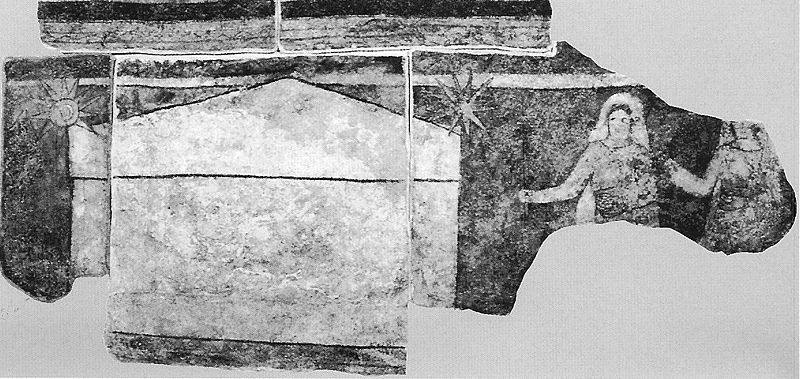
Dura-Europos was a Christian house church dating to 235 A.D.

In it are frescos depicting Adam and Eve, what is assumed to be the three Mary's approaching the tomb, and the Good Shepherd image. The fact women were included on the walls of this house of corporate worship could be simple cultural style or may reflect something more. The fact their participation in significant Gospel scenes is noteworthy and should be considered against the more grating refrains chanting: " a woman must be silent", etc. Eve, and all of her daughters, would be constant and visual teachers of the Gospel message via the artwork.

The house consists of living quarters, afew smaller rooms, and a common room but apparently lacks the sexual segregation aspects often assumed of the synagoues. There is a baptismal area with a shallow pool indicating probably immersion was not practised in the house but this could have happened, as many have noted, in the river nearby if a believer or doctrine required.

This is important because it indicates something different was going on in the Christian worship site. While authors argue woman was segregated and the disciples addressed the males in their pastoral epistles, the house church seems to undermine that argument.

As one of the earliest church houses and containing important images (the earliest image of Christ was found there), the site is largely unknown. Far greater emphasis is on the Jewish synagogue and the implications of the Christian worship center are laregely ignored.

[Image public domain ]

HEY YOU GUYS!

"Brothers" or "Brothers and Sisters"?

As a child growing up in Kansas, the term ‘Guys’ had no connection to gender it was more an informal collective noun referring to any group of people regardless to sex. “Hey guys, let’s go play on the swings.” “Those guys over there want to play a game.” “Guys!!!! Wait up…..”

I remember the first time I used this outside of Kansas. Half of the assembled group responded with an irate: “What! We’re not guys!”

I wonder if someone had been writing down all the times I, and others like me, used the term informally as ‘people’, would they one day interpret that I had meant only the men? Maybe that is just what the issue of the New Testament use of the term ‘Brothers’ (adelphos) implies. Ancient sources reveal evidence that the masculine plural forms of the noun could, depending on contexts, have a gender-neutral sense and mean both sexes (see the Bauer-Arndt-Gingrich Lexicon (2nd ed., 1979).

A review of the uses of the term translated “Brothers”, indicates few instances where gender is an issue unless one is overly concerned with issues of male superiority, authority, or propriety. There are, however, in applying a strict rule, repeated problems challenging the scope of the Gospel presented, the membership of the ‘church’, and the attitude of the disciples to the followers.

Scope of the Gospel
Internal logic alone calls into question the strict use of a male specific rendering of adelphos as a steadfast rule. If there is evidence in other sources of a gender-neutral use of the term, could there also be an informal and general use of the term similar to the way ‘guys’ can be used? If not, there is a massive exclusion of women in the New Testament pastorals which conflicts with the actions and words of Jesus Christ in the Gospels.

Membership in the “Church”
The Pauline corpus uses the term “brothers’ (adelphos) heavily, yet included in many of the letters are instances of a larger intended audience. Some authors argue that the early church was gender segregated and cite the remains of the synagogue at the Syrian Dura-Europos . Yet, one of the early house churches (this one dated to ca 235 A.D.) is also located there complete with a single hall and frescos depicting Gospel events, Adam and Eve, and utilizing the imagery of the “Good Shepherd”. Some even depict women of the Gospels and show the three Mary’s approaching the tomb.

Attitude of the Disciples
To Be Continued.....


See Also: http://www.archaeology.org/online/features/dura_europos/

12/12/2010

LIVING UNDER A CURSE


Recently, I was reviewing a situation, and the only answer to the problems presented seemed to be the possibility of a curse. Now, I am not one to lightly bandy that term around. I feel it has been misused in the past and used far too glibly. Yet, in this situation it seems to fit.


At issue: An institution unable to get ahead, unable to achieve any of its goals, to become what its destiny implied, unable to identify and follow a vision with honor, and an institution with a track record of viewing its human resources as a disposable commodity. This last element, especially, seems the most likely vehicle by which a "curse" or similar proclamation may have been levied.


Such actions tend to generate discord, if not downright hate, and from such hurt and pain arise careless actions or words. Such actions also tend to violate solid Christian principles of righteous actions and fundamental principles of ethics, love, and concern.


CURSING ELEMENTS

How were those O.T. curses voiced? They often included declarations that -


1. Your Plans would come to naught. Despite strategic plans, goals, well orchestrated emphasis, and visions of possibilities, there is in the end complete failure. The target is not reached. Every effort falls terribly short of its intended goal despite all efforts to the contrary.


2. Your Wells would go dry. Wells provide nourishment, they enhance life by their existence (shade and life emerge around the well or watering place). The water is symbolic of new life, of cleansing, and renewal with new purpose.


3. Your Herds would not increase. The herd can be symbolic of economic stability and blessing. The herd can be symbolic of discipleship and growth. The herd is the future and the reproduction, addition, and improving of that herd were keys to stability, growth, and future life.


4. You are spurned. Like Cain there seems to be a sign reading 'loser' or some other sign that keeps quality customers at bay but attracts negativity. Over all, there is the sense that the darkness embraces even as the light spurns the business, group, or agency.
COMMON CHARACTERISTICS
These objects of prophetic pronouncements often seemed to share some common characteristics as well.


1. They closed their ears. They did not listen to advice, warnings, or words of wisdom to change their ways, correct their course, or rethink their strategies. Pride had stepped in to steal their humility. They did not hear the cries for compassion, help, or mercy. They did not hear the warnings or the counsel.


2. They closed their eyes. They did not see what was before them, pr they chose to be too selective in what they did see. They saw what they wanted to see and they urged movement to the wrong landmarks as a result. They did not hear the cries of the widows, the orphans, the hungry, or the injured (physical or metaphorical).


3. They closed their mouths. They did not speak up when they saw error, sin, or crime on every side. They did not dare to disagree when the decisions were made that headed them toward the shoals of unethical actions, unscriptural conduct, or illogical thinking.


In uncontrolled power lies the bitter root of sin, the lure of hubris, and the inevitable outcome of pain. In power lies the ability to generate fear and control. This Fear keeps the ears, eyes, and mouths closed. Fear gives the ungodly control. Fear is the tool of those who who seek to destroy. As the Bible says where there is envy and strife, and selfish ambition, there is “confusion and every evil work” (James 3:16).


In WW2 a pastor, Martin Niemoller write a poem...."In Germany they came first for the Communists, and I didn't speak up because I wasn't a Communist. Then they came for the Jews, and I didn't speak up because I wasn't a Jew. Then they came for the trade unionists, and I didn't speak up because I wasn't a trade unionist. Then they came for the Catholics, and I didn't speak up because I was a Protestant. Then they came for me, and by that time no one was left to speak up."


Fear, unconcern, and the refusal to be fully aware of what is going on around combine to create a deadly situation. This is the opposite of what the Bible says the Christian is to be and to do.


"But the wisdom that is from above, is first pure, then peaceable, gentle, and easy to be entreated, full of mercy and good fruits, without partiality and hypocrisy" (James 3:16-17).


The hurting person who intentionally or unknowingly lays down a curse can only place that curse on those who do not operate in that "wisdom that is from above". Those who are being pure, peaceable, gentle, merciful, without partiality or hypocrisy, have nothing to fear.


THE CURE


"Come let us reason together" and 1) search the heart of the self, the institution, and the cause to determine if there is a curse and why it is able to negatively impact our setting. 2) Then, corporately repent, 3) seek out those wronged and make restitution or seek forgiveness, and 4) then make the changes necessary to be a Godly, righteous, and ethical place.


Then....and only then....will real advancement or achievemenets be made.

10/09/2010

I LIKE IT OUT IN THE OPEN: SENSUAL IMAGERY AND WOMEN

A recent furor has been raised by the 'suggestive' postings of women on social networking sites. The problem appears to rest not so much with what is said but how people interpret what is said. Words are worrisome things and can hinder as well as help clear communication.
If beauty is in the eye of the beholder than just as surely lustful thoughts, suggestive inflections, and tawdry intepretations may be influenced by the human filter through which they pass. Namely, you and I. I have known people who if the word 'red' was written on a wall they would inhale, cover the eyes of small children, and hurry away, tongue clicking at the indecency. I have seen those same people mock, belittle, denigrate, slander, insult, and ridicule with words and 'suggestive' inflections without anyone calling them to account.
Larger issues of cultural confusion, Christian cultural confusion, cloud the issue. Through layers of church history, inferior interpretations, and hare-brained hermenuetic there is often a view of women as 'creators' of lust, temptresses, inferior mental stamina, and vapid moral character.
For some, who mis-read Paul and Peter's words in the New Testament and largely ignore those of Jesus, Woman is eternally standing in the Garden offering poor, innocent Adam a forbidden fruit.
Woman, as the being created by God, has been maligned and in so doing so too has the Man. The Song of Solomon celebrates the physical nature of human sexual interaction as a joyful, playful and satisfying experience. What we have done is blame one gender over another, instill artifical standards of purity, and build walls that tend to heighten rather than control natural sexual responses.
Holiness - in life, thoughts, and actions - is more than being surrounded by people in non-revealing clothing. If that were the case, the Victorian era would have been one of the holiest and yet sexual sin was rampant in the day when a glimpse of ankle was scandalous. If that were the case, the lives of peoples in cultures where clothing is mimimal or missing would be torrid centers of scandalous living - yet they are most often the opposite. Pacific Islanders did have trouble with women going topless in pre-colonial Hawaii; the Missionaries and others who worked there had the problems and how they responded was a means of safeguarding themselves rather than those they sought to minister to.
When we assume that anything sexual is sinful we set ourselves up for a series of problems. When we assume we can do anything sexual we set ourselves up for a series of problems. It is the middle, in the balance, where we must reside to safeguard healthy, God-given reactions with the ability to control animalistic urges. This is done through character, ethics, respect, and Christ working within the man or the woman to see the best of God's creation.

9/05/2010

ONE CHOCOLATE BAR SACRIFICES

I remember hearing or reading an interview of French film personality, Leslie Caron talking about the deprivations she and her country had suffered under Hitler. She recalled the soldiers coming through and giving them their extra chocolate bars. They were treats but later she observed that one of the main differences in their relative experiences was for the American it was simply losing one of two bars but for her and her countrymen it was having no chocolate bar at all.

Dietrich Bonhoeffer, killed in WW2, also recognized that sometimes we can be guilty of wanting a cheap grace with a small price tag. As he said:"To endure the cross is not tragedy; it is the suffering which is the fruit of an exclusive allegiance to Jesus Christ.” As a man ultimately killed for his position standing against the Nazi and his faithful beliefs, Bonhoeffer had understanding of the reality of suffering and a cross in the life of the believer.
As Jesus, 'take up your cross' if one desired to follow him. The way is not easy, what good thing comes without pain, sweat, or cost?
Our problem may be we have lived overly long with the sacrifice of one of our two candy bars. Sacrifice is what someone else does. Sacrifice is an abstract which holds little reality in our instant gratification paradigm of normalcy.

9/01/2010

Muzzeling the Ox: Women Today

There is statement in the Bible reminding people of the unwise move of muzzeling the ox that is working to grind the corn or the grain to be made into bread. Life and economic vitality depended on the strength of the ox to work at the thankless task.
I was struck lately with how apt an illustration that is for woman in the church sometimes. She is hidden away, working thankless and repeatitive duties, and some want to muzzle her as well.
What happens when an ox gets hungry? When it is not cared for or tended to with respect? It looses strength, withers and dies, OR it can grow frustrated, anxious and break out to escape the servitude of its bondage.

6/13/2010

SEEING AND SEEING. M.HUDSON


SEEING AND SEEING
The disciples looked at one another; someone had forgotten to bring the food. After a check of the ship they found only a single loaf of bread to be shared between them. Each one's glance drifted guiltily to where Jesus stood at the side of the ship looking toward the far shore. Since leaving the group of Pharisees who had tried to waylay him with their tricks and questions he had stood like that. He was probably even more hungry than they, and all they had was a loaf of bread.

From where they were grouped they heard Jesus speak in a tone he used when there was something he particularly wanted them to know. "Listen to what I have to say," he commanded them. "Beware of the leaven of the Pharisees and of the leaven of Herod."

Talking among themselves they decided that Jesus knew they had not made provision for food and that he was displeased with them. Although they Had spoken in whispers, Jesus turned to them asking: "Why do you think that I spoke about the absence of food? Do you not understand yet-do you not grasp what I mean? Are your hearts hardened to me already? "You have eyes, can you not see? You have ears, can't you hear, and do you so soon forget all that I have spoken to you? When I broke the five loaves of bread among the five thousand who had come to hear me teach, how many baskets full of food were taken up after all had eaten?"


"Twelve baskets, Master," they told Him."If I could supply the need then, what is to stop me from doing the same now?" Noticing the blank looks still on their faces he asked: "How is it that you do not yet understand?" There is a difference in seeing and really taking in what is seen. One merely catches the visual impressions. The other catches it and analyzes it. Then the person comes to an understanding. Some people never get past the "surface- skimming" stage. From a human standpoint Jesus might well have despaired that his followers-those twelve, hand-picked men, who would turn the world upside down-would ever graduate past the skimming stage. But Christ was, among other things, their Teacher. Almost immediately, He set about to impress something on those men. In a group gathered to one side of the road the disciples watched as Jesus took the blind man by the hand to lead him away from the town. Jesus spat upon the eyes and asked him what he could see. The man looked around: "I see men who are like walking trees. It is all very unclear." As he finished speaking Jesus placed his hands on the man's eyes and told him to look again. "I can see! I can see clearly now!" He cried to the crowd as his sight was restored, "I can finally see."

The man had been blind, unable to see the sky, his friends, or even his own family; however, Jesus didn't heal him right away as he had in other cases. Instead, He touched him once and then the man reported that he saw but the images were obscure and out of focus. Perhaps Jesus looked at his disciples then, wondering if they
were grasping the analogy.

Earlier, on board the ship they had "seen" what Jesus said, but it was out of focus, badly distorted. They loved Jesus but they had not come to the place where they did more than skim the surface of the relationship available to the Son of God.

Like you and me, the disciples had caught the visual impression on the soul's retina, so they bickered, murmured, were jealous and unkind until, they, like the blind man, were touched anew and cast off their spiritual blindness to see really see-the meaning behind the coming, the teaching, and the victorious death of Jesus Christ. It is the difference between merely making a casual acceptance of Christ's teachings, and taking in what He taught, studying it, and coming to an understanding of God's will and plans for life. It is the difference in living a life of sight in spiritual concern and maturity, or remaining blinded.


It is the difference between seeing ... and really seeing

HIS BOW ABODE IN STRENGTH.


HIS BOW ABODE IN STRENGTH

It was done.
The sun hid its face behind countless grieving clouds. The wind quickened to carry the word of mourning. The earth arose as if it wept. Laughing, vulgar faces abruptly ceased their reveling as darkness and fear sent them scurrying down the road seeking safety.

A small group remained, infinitesimal in comparison to the cheering crowds of just a few days before. A mother, a friend, a handful of women, an unknown number of acquaintances.

How, we ask, could those desert Him who followed Him for months, even years. How could the press of the crowds clamoring after the miracles, the healings, and the words He spoke, be reduced to a lonely handful on a hill?


We know the answer - for it is within ourselves. Their human frailty is our weakness. Their lack of faith is our absence of trust, Their humanity is ours.

In our doubt and unbelief, do we run to hide in a cave. When about us the ungodly grow full of earth's best, do we grumble at what we feel should be he spoils of this life? When we are straining beneath the load of, do we complain because one walks unfettered? When the way grows hard or our sun hidden by grief, do we hurry to bury our faces beneath the cover of solace?

The Cross. His cross and our cross. Can we stay by the side of Jesus regardless of outside influences or apprehensions? Can we be described in the terms Jacob used in his death-bed blessing of Joseph:
. . . the archers sorely grieved him, and shot him and hated him,
but his bow abode in strength, and the arms of his hands were
made strong by the hands of the mighty God of Jacob

(Genesis 49:23, 24).

M.HUDSON

5/24/2010

SEEING AND SEEING. MARILYN A. HUDSON

SEEING AND SEEING
The disciples looked at one another; someone had forgotten to bring the food. After a check of the ship they found only a single loaf of bread to be shared between them. Each one's glance drifted guiltily to where Jesus stood at the side of the ship looking toward the far shore. Since leaving the group of Pharisees who had tried to waylay him with their tricks and questions he had stood like that. He was probably even more hungry than they, and all they had was a loaf of bread.

From where they were grouped they heard Jesus speak in a tone he used when there was something he particularly wanted them to know. "Listen to what I have to say," he commanded them. "Beware of the leaven of the Pharisees and of the leaven of Herod."

Talking among themselves they decided that Jesus knew they had not made provision for food and that he was displeased with them. Although they Had spoken in whispers, Jesus turned to them asking: "Why do you think that I spoke about the absence of food? Do you not understand yet-do you not grasp what I mean? Are your hearts hardened to me already? "You have eyes, can you not see? You have ears, can't you hear, and do you so soon forget all that I have spoken to you? When I broke the five loaves of bread among the five thousand who had come to hear me teach, how many baskets full of food were taken up after all had eaten?"
"Twelve baskets, Master," they told Him."If I could supply the need then, what is to stop me from doing the same now?" Noticing the blank looks still on their faces he asked: "How is it that you do not yet understand?" There is a difference in seeing and really taking in what is seen. One merely catches the visual impressions. The other catches it and analyzes it. Then the person comes to an understanding. Some people never get past the "surface- skimming" stage. From a human standpoint Jesus might well have despaired that his followers-those twelve, hand-picked men, who would turn the world upside down-would ever graduate past the skimming stage. But Christ was, among other things, their Teacher. Almost immediately, He set about to impress something on those men. In a group gathered to one side of the road the disciples watched as Jesus took the blind man by the hand to lead him away from the town. Jesus spat upon the eyes and asked him what he could see. The man looked around: "I see men who are like walking trees. It is all very unclear." As he finished speaking Jesus placed his hands on the man's eyes and told him to look again. "I can see! I can see clearly now!" He cried to the crowd as his sight was restored, "I can finally see."

The man had been blind, unable to see the sky, his friends, or even his own family; however, Jesus didn't heal him right away as he had in other cases. Instead, He touched him once and then the man reported that he saw but the images were obscure and out of focus. Perhaps Jesus looked at his disciples then, wondering if they
were grasping the analogy.

Earlier, on board the ship they had "seen" what Jesus said, but it was out of focus, badly distorted. They loved Jesus but they had not come to the place where they did more than skim the surface of the relationship available to the Son of God.

Like you and me, the disciples had caught the visual impression on the soul's retina, so they bickered, murmured, were jealous and unkind until, they, like the blind man, were touched anew and cast off their spiritual blindness to see really see-the meaning behind the coming, the teaching, and the victorious death of Jesus Christ. It is the difference between merely making a casual acceptance of Christ's teachings, and taking in what He taught, studying it, and coming to an understanding of God's will and plans for life. It is the difference in living a life of sight in spiritual concern and maturity, or remaining blinded. It is the difference between seeing ... and really seeing

Biography

Biography
Noel Brooks: A Life Shining and Burning, 1914-2006

Waiting...Renewing...Moving

Waiting...Renewing...Moving

Huldah's Gate Badge - Men and Women Before God

Huldah's Gate Badge - Men and Women Before God
Feel free to add this to your webpage

Contact Information

If you would like more information on implementing a Daughters of Huldah or a Sisters of Huldah group in your church or community, or in starting a RFA chapter please contact:

Marilyn A. Hudson
marilynahudsonATyahoo.com
please place on the subject line the site name or it will be deleted as spam.